
Cold email vs cold calling vs LinkedIn outreach isn’t really a question with one winner — each channel converts differently, scales differently, and costs differently, and the right answer depends on your deal size, your ICP, and how much manual effort you can put behind it. This guide breaks down what 2026 benchmark data actually shows for each channel, where they overlap, and how the best-performing B2B teams combine them rather than picking just one.
The Short Answer
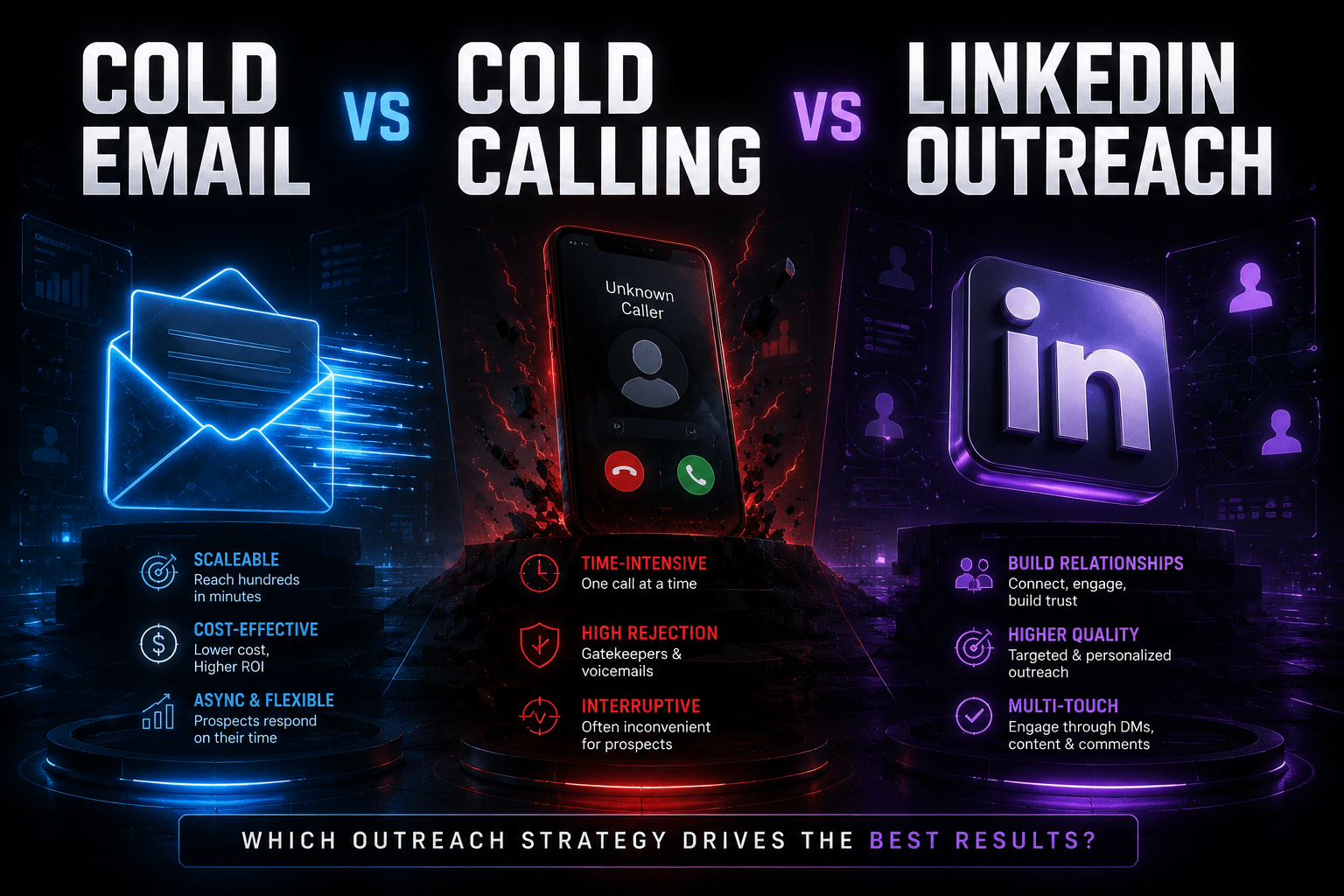
If you need one sentence: cold email wins on scale and cost-efficiency, LinkedIn wins on reply rate and relationship quality, and cold calling wins on speed-to-conversation once you get someone live. Teams running all three in a coordinated sequence consistently outperform teams running any single channel alone — multichannel campaigns are widely reported to produce two to three times the replies of a single-channel approach.
Cold Email: Reach at Scale, Compressed Reply Rates
Cold email’s biggest advantage has always been volume. One person can send 200-500 personalized emails a day through automation, something no other outbound channel comes close to matching.
The tradeoff is that reply rates have compressed hard over the past few years. Platform-wide averages have fallen from roughly 8% in 2019 to somewhere in the 3-4% range in 2026, driven by inbox saturation, tighter Gmail and Outlook spam enforcement, and a wave of low-effort AI-generated outreach flooding inboxes. That said, the gap between average and top-performing campaigns is enormous — tightly targeted, deeply personalized campaigns still reach 8-12% reply rates, sometimes higher on very small, precise lists.
Where cold email wins:
- Cost per contact is lower than any other channel by a wide margin
- No daily send-volume ceiling the way LinkedIn imposes
- Scales cleanly across large, well-defined ICPs
- Works well as the “always-on” layer underneath other channels
Where it struggles:
- Requires real technical setup (domains, DNS authentication, warmup) to land in the inbox at all
- Reply quality is more variable — a portion of replies are auto-responses or “not interested”
- Harder to stand out without genuine personalization, and most senders don’t personalize beyond a first name
Cold Calling: Slower to Scale, Faster to a Real Conversation
Cold calling is the oldest channel in this comparison and, in a lot of B2B pipelines, still the fastest way to get an actual conversation once someone picks up.
Roughly 80% of cold calls go to voicemail, and an SDR working a full day typically manages 80-100 dials for around 15-25 real connections. But once a prospect is live on the phone, conversion is strong: connect-to-conversation rates run 5-8% of total dials, and top-performing reps convert up to 15% of live conversations into a booked meeting. The overall “success rate” across every attempt — voicemails included — sits around 2%, which sounds low until you compare it to how few of those attempts ever produce a real two-way conversation on other channels.
Where cold calling wins:
- Immediate, synchronous conversation — no waiting on a reply
- Highest conversion once you’re actually talking to someone
- Effective for senior buyers, who by some surveys prefer phone contact over email for time-sensitive topics
Where it struggles:
- Labor-intensive — it doesn’t scale the way email does, since it requires a real person’s time per dial
- Low answer rates mean most effort goes into unanswered attempts
- Requires more skill and coaching to execute well than writing a sequence
LinkedIn Outreach: Highest Reply Rate, Lowest Volume Ceiling
LinkedIn consistently posts the highest reply rates of the three channels — but with a volume cap that keeps it from replacing email at scale.
Connection request acceptance rates average somewhere in the 25-30% range for broad targeting, climbing to 40-50% with tightly matched ICPs. Once connected, message reply rates commonly land around 10%, with well-targeted, personalized sequences reaching considerably higher. InMail campaigns (which don’t require a prior connection) show wide variance across studies, generally landing somewhere between 10-25% for standard campaigns and higher for premium, highly personalized sends.
The catch is volume. LinkedIn’s platform limits and account-health algorithms cap safe sending at roughly 15-20 connection requests a day for most accounts — a fraction of what email allows. Push past that and LinkedIn’s own systems start throttling the account.
Where LinkedIn wins:
- Highest reply rate of the three channels by most 2026 benchmarks
- Built-in context — prospects can see your profile, mutual connections, and shared history before responding
- Strong for senior, harder-to-reach buyers who are more active on the platform than in their inbox
Where it struggles:
- Hard volume ceiling makes it unsuitable as a standalone scaling channel
- Account health is fragile — aggressive sending or automation tools can trigger restrictions
- Less effective outside more LinkedIn-active industries like SaaS, agencies, and professional services
Cold Email vs Cold Calling vs LinkedIn: Side-by-Side
| Cold Email | Cold Calling | ||
|---|---|---|---|
| Typical reply rate | 3-4% average, 8-12% top performers | 5-8% connect rate, ~2% overall success | ~10% average, 20%+ for targeted sequences |
| Daily volume ceiling | 200-500+ per sender | 80-100 dials, ~15-25 live | 15-20 connection requests |
| Setup effort | High (domains, DNS, warmup) | Low (a phone and a list) | Low-moderate |
| Cost per contact | Lowest | Highest (labor-intensive) | Moderate |
| Best for | Scaling outreach across a defined ICP | Senior buyers, urgent or high-value deals | Relationship-driven, senior B2B buyers |
Which Channel Should You Actually Use?
The honest answer, backed by most 2026 benchmark studies: it depends on deal size and available effort, but the highest-performing teams don’t pick just one.
If you’re selling a lower-touch, higher-volume offer — think smaller deal sizes, broader ICP, self-serve or short sales cycles — cold email’s scale advantage usually wins on its own. You can reach far more of your ICP for the same effort.
If you’re selling a high-value, senior-buyer offer — enterprise deals, long sales cycles, a narrow list of named accounts — LinkedIn and cold calling both outperform email on a per-contact basis, and the extra effort per prospect is easier to justify against a larger deal size.
The strongest performers combine channels. A common, well-supported sequence: LinkedIn connection request on day one, a cold email on day three, a LinkedIn follow-up message around day seven, and a call layered in wherever the deal size justifies the time. Reported results for coordinated multichannel sequences run consistently higher than any single channel — largely because each touchpoint builds familiarity for the next one, rather than each channel starting cold on its own.
What This Means for Service Businesses Specifically
For agencies, consultancies, and B2B service providers — the audience most likely reading this — cold email is usually still the right foundation, for a simple reason: service businesses typically need volume to find the right-fit prospects, and email is the only channel that scales to that volume without proportional labor cost. LinkedIn and calling both work well layered on top, especially for the highest-value accounts on your list, but building the entire motion around LinkedIn or cold calling alone rarely produces enough pipeline volume to be predictable month over month.
Frequently Asked Questions
Is cold email dead in 2026? No, but it’s harder than it used to be. Reply rates have fallen because of inbox saturation and low-effort AI-generated outreach, not because the channel stopped working. Well-targeted, properly set up campaigns still perform well above the platform average.
Is LinkedIn outreach better than cold email? LinkedIn typically shows a higher reply rate per contact, but it has a much lower daily volume ceiling. For most B2B teams, “better” depends on whether you need scale (email) or reply quality on a smaller list (LinkedIn).
Should I combine cold email, cold calling, and LinkedIn? For most B2B offers, yes. Coordinated multichannel sequences consistently outperform any single channel, since each touchpoint makes the next one land better rather than starting from zero each time.
Which channel is cheapest per meeting booked? Cold email is generally the lowest cost per contact by a wide margin, since it doesn’t require a person’s time per touch the way calling does. LinkedIn sits in between — low direct cost, but capped volume limits total output.
Do these channels work the same for every industry? No. Reply rates vary meaningfully by industry — SaaS and professional services tend to see stronger cold email performance, while LinkedIn tends to perform better in industries with high platform activity among decision-makers, such as agencies, consulting, and tech.
Where This Leaves You
Cold email vs cold calling vs LinkedIn outreach isn’t a competition with a single correct winner — it’s a set of tradeoffs between scale, cost, and reply quality that should match your offer and deal size. For most service businesses, cold email provides the volume foundation, with LinkedIn and calling layered in for the accounts worth the extra effort.
If you’d rather have the cold email side built and managed properly — domains, warmup, targeting, sequences, reply routing — that’s the full scope of what Sentinel’s Reach does. Book a call if you want to talk through where outbound fits into your pipeline.